
01
What intellectual property law covers
Each right draws on its own body of law. The USPTO's glossary (opens in a new tab) defines intellectual property as "Creations of the mind" and counts four ways to protect it, but that entry defines intellectual property rather than the law about it. The Copyright Office, in its general FAQ, calls copyright "a form of intellectual property law".
Patents and copyright rest on the Intellectual Property Clause of Article I, Section 8, which lets Congress promote "the Progress of Science and useful Arts, by securing for limited Times to Authors and Inventors the exclusive Right to their respective Writings and Discoveries" (National Archives transcript (opens in a new tab)). The clause does not mention trademarks or trade secrets. USPTO training slides from 2019 give the source of trademark law as federal law plus state and common law, and the source of trade secret law as state and common law. Cornell's Wex entry states that patents and copyright are regulated exclusively by federal law and trade secrets largely by the states.
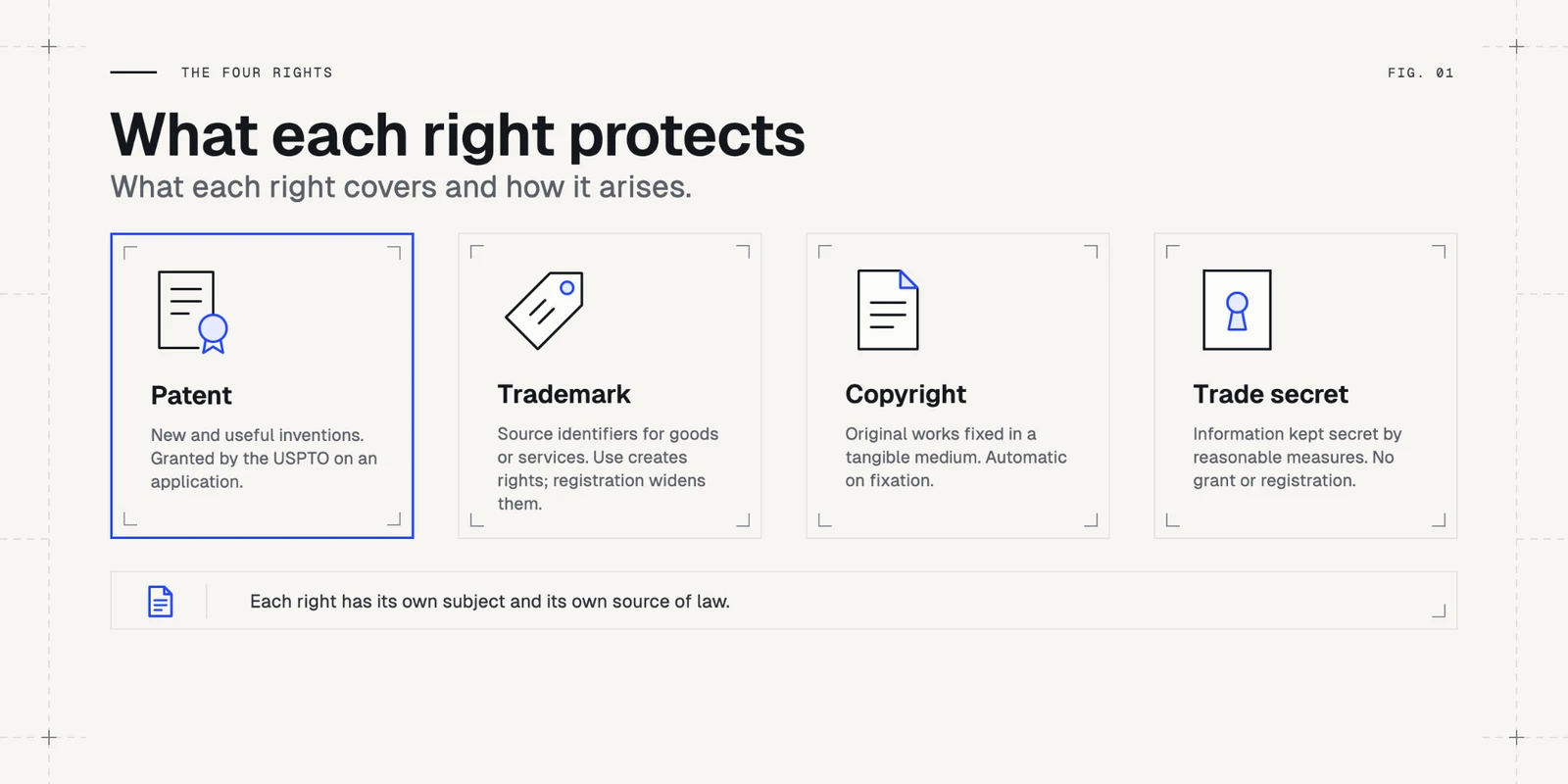
| Right | What it protects | How it arises | Main source of law |
|---|---|---|---|
| Patent | New and useful inventions, plant varieties and ornamental designs | Granted by the USPTO on an application | Title 35 of the U.S. Code |
| Trademark | Words, names, symbols or devices that identify the source of goods or services | Use creates rights; federal registration at the USPTO widens them | Lanham Act (15 U.S.C.); state and common law |
| Copyright | Original works of authorship fixed in a tangible medium of expression | Automatic on fixation; registration is voluntary | Copyright Act (17 U.S.C.) |
| Trade secret | Information with independent economic value that the owner protects by reasonable measures | No grant or registration; it lasts while its elements hold | 18 U.S.C. 1839 and 1836; state law |
02
Patents: a right to exclude for a limited time
Under 35 U.S.C. 154 (opens in a new tab), a patent gives its owner the right to exclude others from making or using the invention and from selling or importing it in the United States. The USPTO's patent essentials page, updated July 20, 2026, frames the grant the other way round: what is granted is not the right to practice the invention but the right to stop others from doing so.
One limit on the grant comes from the USPTO's page about managing a patent (updated October 20, 2025): the holder's ability to practice the invention depends on the rights of others. After the term ends, anyone may use the invention without permission unless other unexpired patents cover it.
Federal patent law categorizes protection into three distinct statutory areas. Section 101 governs utility patents for new and useful processes, machinery, manufactured products, and chemical compositions. Section 161 extends protection to newly discovered or created plant varieties reproduced asexually, while Section 171 covers original ornamental designs created for physical goods.
The terms and post-issuance rules also differ by patent category. A standard utility patent lasts 20 years starting from its earliest filed application date, excluding any term extensions granted under Section 154(b). In contrast, design patents issued on applications filed May 13, 2015 or later remain valid for 15 years from the issue date pursuant to Section 173. Unlike utility patents, design and plant patents require no ongoing maintenance fees under Title 35, Section 41(b)(3). Finally, official USPTO guidelines clarify that notices like "Patent Pending" serve only an informational purpose: actual legal remedies and protection take effect only after the patent formally issues.
03
Trademarks: rights from use, widened by registration
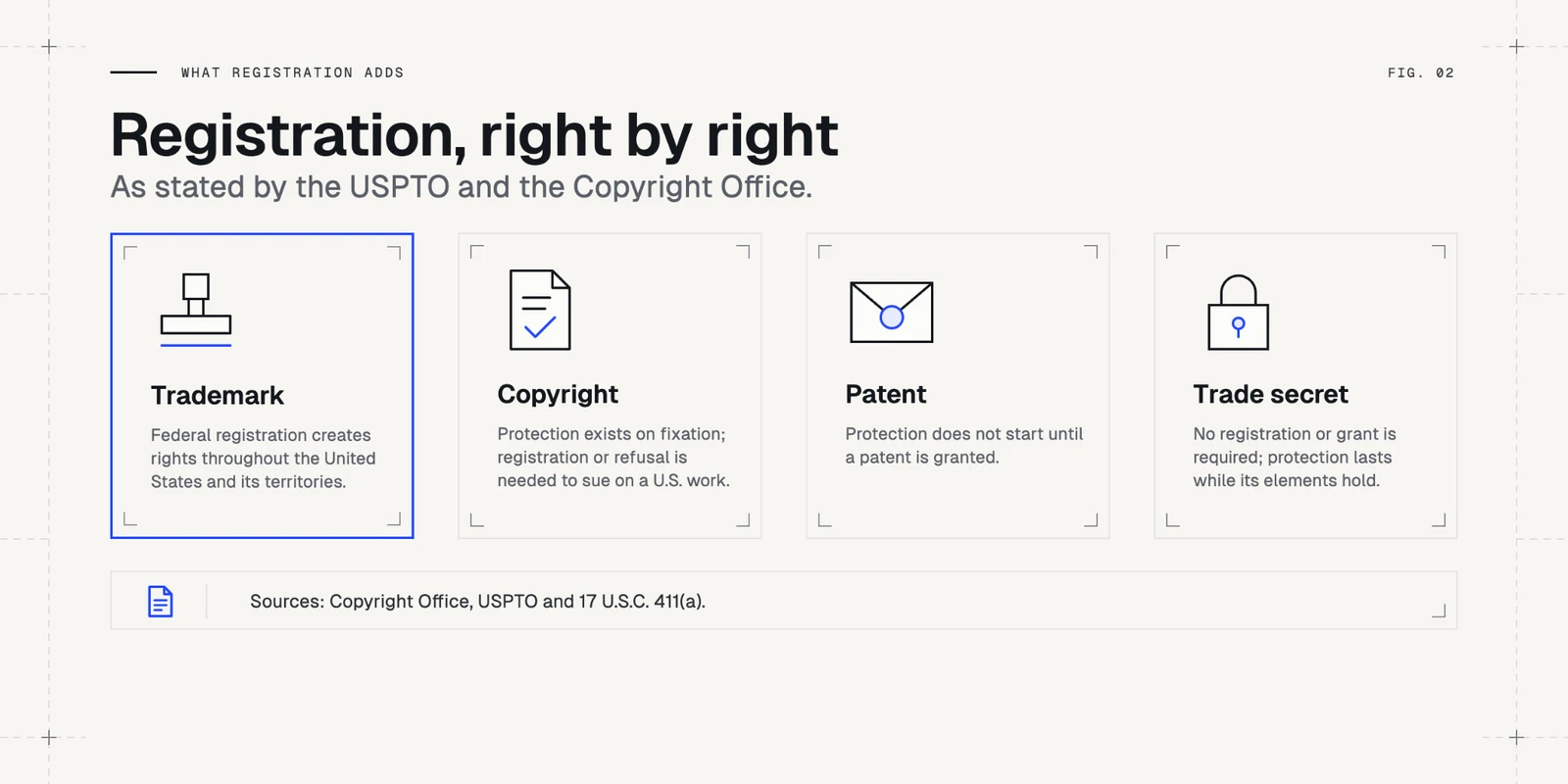
Ownership of a trademark begins with use, and the mark identifies the source of goods or services. The USPTO's page on what a trademark is (opens in a new tab) (updated November 30, 2023) states: "You become a trademark owner as soon as you start using your trademark with your goods or services."
Those rights are limited to the geographic area in which the goods or services are provided, according to the same page. The USPTO's page on why to register (updated May 17, 2024) describes federal registration as one that "creates rights throughout the entire United States and its territories" while state registration "creates rights in that state only."
Registration is optional. A certificate on the principal register is prima facie evidence of the validity of the mark and of the owner's ownership under 15 U.S.C. 1057.
Registration "can last forever" under USPTO guidance, so long as the owner keeps using the mark in commerce and files evidence of that use. USPTO slides revised in October 2020 carry a reminder of their own: a trademark is not a business license.
04
Copyright: automatic protection, with registration needed for court
Copyright protection exists automatically from the moment an original work of authorship is fixed in a tangible form, according to the Copyright Office's Circular 1 (opens in a new tab) (revised September 2021). Registration is not a condition of protection under 17 U.S.C. 408(a), . Publication isn't necessary either, the Office's FAQ states. Originality, in the Circular's words, means a creation "independently created by a human author" with at least some minimal creativity.
In court, registration matters for a United States work. Under 17 U.S.C. 411(a), an infringement suit cannot be started until registration has been made, though an applicant whose registration was refused may sue by serving notice and a copy of the complaint on the Register of Copyrights. Section 412 withholds statutory damages and attorney's fees from infringement that began before registration unless registration is made within three months after first publication.
For works created on or after January 1, 1978, the term is the life of the author plus 70 years (17 U.S.C. 302(a)).
05
Trade secrets: protection with no registration and no fixed term
A trade secret is information that its owner keeps confidential by reasonable measures and that has independent economic value because it is not generally known, as 18 U.S.C. 1839 (opens in a new tab) defines it.
Three elements define the protection, according to the USPTO's trade secret policy page (updated July 29, 2026), and all three are required. If one ceases to exist, the protection ceases with it. Otherwise there is no limit on how long it lasts. Unlike a patent, a trade secret needs neither registration nor a government grant, according to Cornell's Wex entry.
Under 18 U.S.C. 1839(6), methods such as reverse engineering and independent creation are recognized as entirely lawful practices. Official USPTO presentation materials explicitly list independent development and reverse engineering, alongside voluntary disclosures authorized by the owner, as primary triggers for forfeiting trade secret status. Copyright filings can also unintentionally compromise confidentiality. As the Copyright Office points out in its guidelines, application materials and deposit copies automatically become public records, making registration inadvisable for sensitive material an owner intends to keep private.
Congress added a federal civil action in the Defend Trade Secrets Act of 2016 (Public Law 114-153, approved May 11, 2016). Suit must begin within 3 years after the misappropriation is discovered or should have been discovered, under 18 U.S.C. 1836. State law covers most of the field: the Uniform Trade Secrets Act is a model text approved in 1979 and amended in 1985, and it binds a state only when the state enacts it.
06
What the rights do not cover
- Patent: the USPTO says patent law defines the limits of what can be patented, and the laws of nature, physical phenomena and abstract ideas cannot be patented, nor can only an idea or suggestion.
- Copyright: the Copyright Office states that copyright does not protect facts or ideas, although it may protect the way they are expressed. Registering a drawing or description, Circular 33 (revised March 2021) points out,"extends only to the original expression" and does not apply to the underlying invention. Names, titles and short phrases lack enough creativity for a copyright claim, though under certain circumstances they "may be protectable under federal or state trademark laws".
- Trademark: the USPTO says you don't have rights to the word or phrase in general, only to how it is used with your specific goods or services.
07
Dates that start or end each right
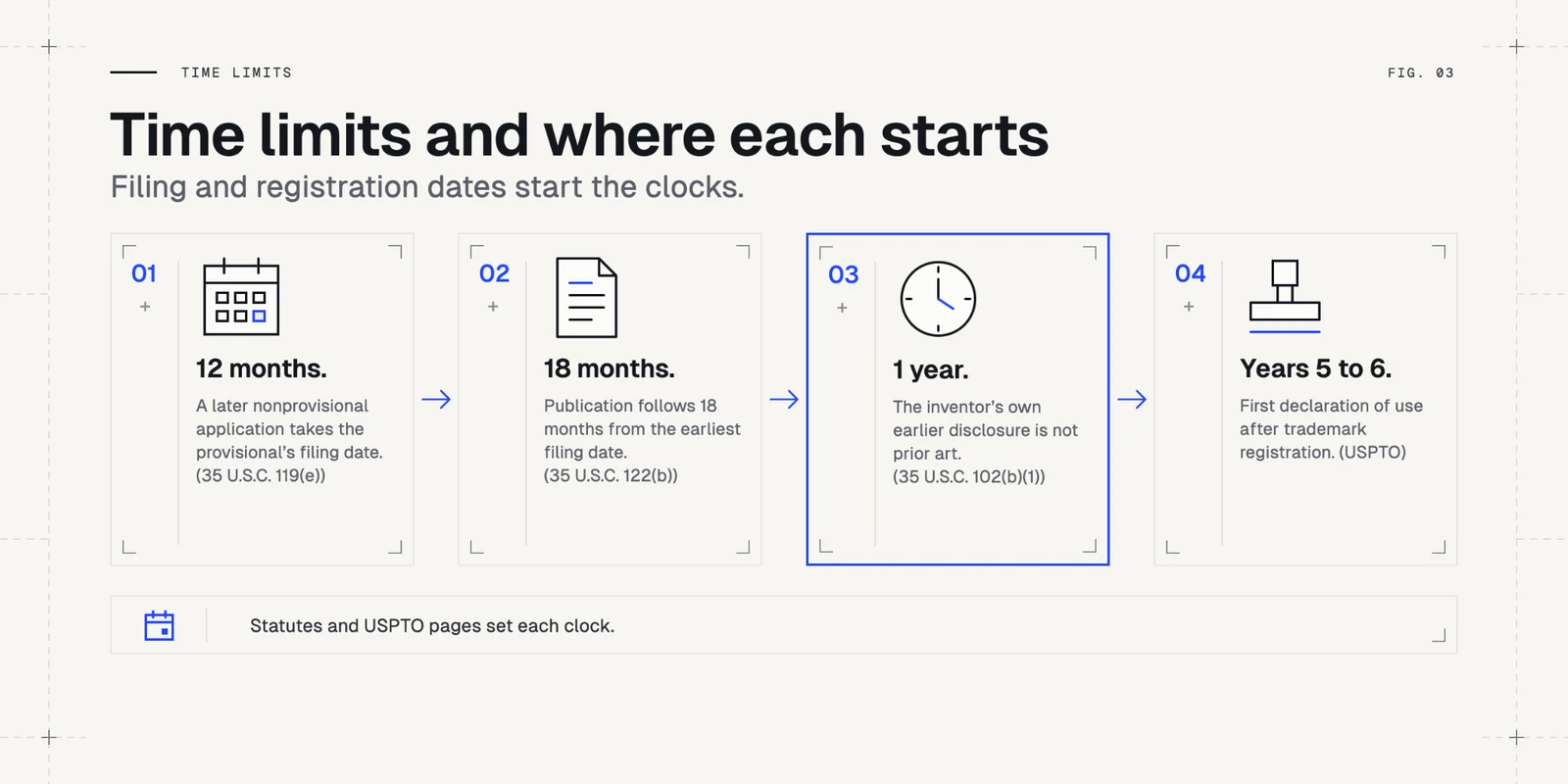
A patent's early dates count from filing, its maintenance dates from issue, and a trademark's maintenance dates from registration.
- Provisional application: a later nonprovisional application takes the provisional's filing date if it is filed not later than 12 months after the provisional (35 U.S.C. 119(e)).
- Publication: each application is published promptly after 18 months from the earliest filing date for which a benefit is sought, subject to the exceptions in paragraph (2) of the section (35 U.S.C. 122(b)).
- Inventor's own disclosure: a disclosure made 1 year or less before the effective filing date is not prior art under 35 U.S.C. 102(b)(1) when the inventor or a joint inventor made it. MPEP 2151 measures that year from the filing date of the earliest application with a proper benefit or priority claim.
- Patent maintenance: fees are payable 3 to 3.5 years, 7 to 7.5 years and 11 to 11.5 years after issue, and the patent expires at the end of the six-month grace period if payment hasn't arrived (35 U.S.C. 41(b); USPTO, updated September 2, 2025).
- Trademark maintenance: a declaration of use falls between the fifth and sixth years after registration; a declaration and renewal fall between the ninth and tenth years and every ten years after, each with a six-month grace period (USPTO, updated September 9, 2025).
08
Who owns what an inventor creates
In Board of Trustees of the Leland Stanford Junior University v. Roche Molecular Systems, Inc. (opens in a new tab), 563 U.S. 776 (2011), the Supreme Court held that the Bayh-Dole Act does not automatically vest title to federally funded inventions in federal contractors. The Court confirmed the general rule: rights in an invention belong to the inventor. It also wrote that "an inventor must expressly grant his rights in an invention to his employer if the employer is to obtain those rights" in most circumstances.
Patents have the attributes of personal property. An application or patent is assignable by an instrument in writing (35 U.S.C. 261). An assignment is void against a later purchaser for value without notice unless it is recorded in the USPTO within three months of its date or before the later purchase.
Marks are assignable with the goodwill of the business in which they are used (15 U.S.C. 1060). Copyright vests initially in the author, and for a work made for hire the employer or other person for whom it was prepared is considered the author (17 U.S.C. 201). A transfer is not valid unless it is in a writing signed by the owner or the owner's agent (17 U.S.C. 204), and owning a copy of a work does not mean owning its copyright, Circular 1 states.
Only natural persons can be named as inventors. The USPTO's inventorship guidance of November 28, 2025 (90 FR 54636) says AI systems cannot be named because they are not natural persons. The Copyright Office's January 2025 report on copyrightability makes the matching point for authorship, that copyright does not extend to purely AI-generated material.
Human conception is the part of the work that this guidance turns on, and Precursal, an AI platform for ideas and patents, lists documenting it among its aims. Its home page describes helping you "explore ideas, uncover white space, research prior art, document human conception, and prepare stronger materials for patent counsel," and under the heading "Walk into counsel better prepared" it names an inventor notebook and an invention disclosure. The footer states that Precursal is not a law firm and does not provide legal advice, that outputs should be reviewed by the user and, where appropriate, qualified patent counsel, and that it does not determine or guarantee novelty, patentability, validity or enforceability.
09
Costs of getting, keeping and enforcing each right
Government fees for patents and trademarks come from the USPTO fee schedule (opens in a new tab) (last revised August 14, 2026), and the Copyright Office's fee page sets copyright registration fees. The patent discounts are 60% for small entities and 80% for micro entities, per the USPTO.
| Right | Fee | Amount in dollars |
|---|---|---|
| Patent | Provisional application filing | 325; small entity 130; micro entity 65 |
| Patent | Utility filing, search and examination together | 2,000; small entity 800; micro entity 400 |
| Patent | Utility issue fee | 1,290; small entity 516; micro entity 258 |
| Patent | Maintenance at 3.5, 7.5 and 11.5 years | 2,150; 4,040; 8,280 |
| Trademark | Base application, per class | 350 |
| Trademark | Combined Section 8 declaration and Section 9 renewal, per class | 650 |
| Copyright | Standard Application, electronic | 65 now; 85 proposed (pending) |
Patent amounts are undiscounted unless the row says otherwise. The filing-stage total adds the basic filing fee (350), the search fee (770) and the examination fee (880). The Copyright Office presented a proposed schedule to Congress on July 14, 2026 that would raise the electronic Standard Application from 65 dollars to 85 and the paper fee from 125 dollars to 185. By law the Register may institute new fees 120 days after submission unless Congress enacts a law disapproving them in that time. Day 120 falls on November 11, 2026. The Office says it seeks to implement them in the fall of 2026.
For patents, 35 U.S.C. 284 requires damages adequate to compensate and in no event less than a reasonable royalty, and the court may increase damages up to three times. For registered marks, 15 U.S.C. 1117 allows recovery of the defendant's profits and the plaintiff's damages, along with the costs of the action.
For copyright, Congress set statutory damages of not less than 750 dollars or more than 30,000 dollars as the court considers just (17 U.S.C. 504(c)). Since the Defend Trade Secrets Act of 2016, exemplary damages for trade secrets may reach 2 times the damages awarded when a secret is willfully and maliciously misappropriated (18 U.S.C. 1836).
10
How the documents bear on an inventor's choice of right
The sharpest line for an inventor runs between a patent and a trade secret. Under 35 U.S.C. 122(b) an application is published promptly after 18 months from its earliest filing date unless an exception applies, and the USPTO's trade secret policy page (updated July 29, 2026) says a trade secret ceases to exist when one of its required elements does. A patent is therefore a choice to disclose, and information meant to stay secret has to stay out of a published filing.
Next comes the calendar. A disclosure by the inventor 1 year or less before the effective filing date is not prior art under 35 U.S.C. 102(b)(1); an earlier one falls outside that exception. Trademark rights arise from use and copyright from fixation, but the USPTO states that patent protection does not start until a patent is granted, so filing dates weigh most on the patent. The fee schedule shows the same split between getting a patent and keeping it: maintenance fees follow issue, and design and plant patents carry none.
11
Frequently asked questions
What is intellectual property law?
It is the set of legal rules for creations of the mind, the phrase the USPTO glossary uses for creative works or ideas embodied in a form that can be shared or recreated. Whether a government filing is needed depends on the right: a patent exists only once the USPTO grants it, a trademark can arise from use alone, copyright exists from fixation, and a trade secret needs no application or registration, according to USPTO and Copyright Office pages.
Does a copyright notice protect my work?
Notice alone does not create protection. Circular 1 says applying a copyright notice has not been required since March 1, 1989, though it may still provide practical and legal benefits, and that a notice is not a substitute for registration. The Office's FAQ states that registration is voluntary in general.
Is a brand the same as a trademark?
Not necessarily: a brand becomes a trademark only if the owner protects it as one. The USPTO says you can have a brand and decide not to protect it by registering it as a trademark. The USPTO also says you may use "TM" for goods or "SM" for services without filing an application, but the registration symbol is limited to the goods or services listed in the federal registration.
Do I need a patent attorney to apply?
An attorney is not required. According to the USPTO's patent essentials page, it is possible to receive a patent on your own, but the Office always recommends a registered patent attorney or agent. The USPTO also recognizes that the cost of legal assistance can be prohibitive, particularly for independent inventors and small businesses, as its page on what a patent is explains.
What happens if I miss a maintenance deadline?
Utility patents expire at the end of the six-month grace period if the maintenance fee is not paid, under 35 U.S.C. 41(b). A trademark registration is canceled by the Director under 15 U.S.C. 1058 unless the owner files the required affidavits in the statutory periods. The fee schedule lists a petition for delayed payment of a patent maintenance fee at 2,260 dollars for a delay of one year or less and 3,000 dollars for longer, undiscounted, per the August 14, 2026 revision.
Who owns a copyright when a contractor creates the work?
The contractor, unless the work qualifies as made for hire. Under 17 U.S.C. 101, a commissioned work qualifies only if the parties expressly agree in a signed written instrument to treat it as made for hire, and the definition also reaches a work prepared by an employee within the scope of employment. Circular 30 (revised August 2024) says the Copyright Act does not define the terms "employee," "employer" or "scope of employment".
Does the USPTO enforce patents and trademarks?
No. The USPTO says it does not have the authority to enforce patents and has no jurisdiction over infringement questions. For trademarks, it says it is not an enforcement agency, so the owner is responsible for pursuing infringing users, and it lists the right to sue in federal court among the benefits of registration.